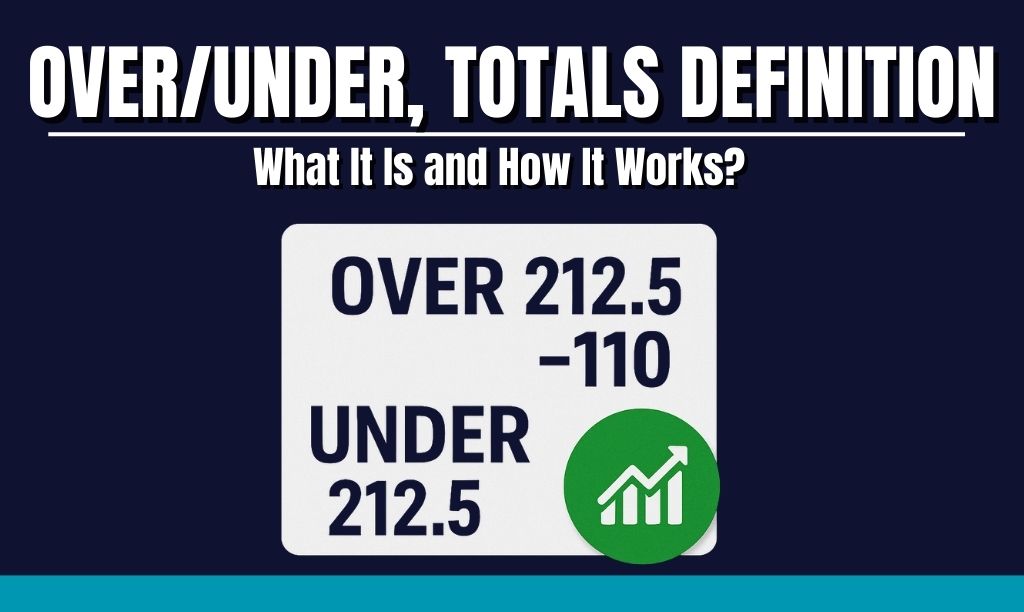
No matter how much experience you have when it comes to sports betting, there are plenty of terms that are important to know before you begin or continue your sports betting journey. One of these terms is the over/under or total.
With that, the guide we have created below will give a complete and comprehensive overview of what the over/under or total is and how it works as it pertains to sports betting.
Over/Under, Totals Definition?
In simple terms, the over/under or total can be defined as the sports betting market that focuses on how many points will be scored in any given game or event.
What is an Over/Under, Totals in Betting?
An over/under is the number set by the Sportsbook that refers to the total amount of points, runs, or goals that are expected to be scored.
Betting a total can be done in many different ways, such as over a full game, through player props, as well as many more.
How Do Over/Under, Totals Work?
When examining how the over/under or total works, it ultimately comes down to two main outcomes. The first is when the total points in a game go over the set total. In this case, bets made on the over would win and be paid out.
The other outcome is the under, which means the points in any given game or event go under the posted total.
However, sometimes a third outcome can occur, which is simply referred to as a push. This means the total points in the game you are betting on lands exactly on the posted total. If this happens, the amount you bet will be returned to your account.
What Happens If the Over/Under, Totals Are Not Covered?
If the over/under or total is not covered in the game you are betting on, it simply means you lost your bet.
For example, if you bet on an over of 55.5 points in a college football game and the game ends with 52 points scored, it means the under won, and the amount you bet will be lost.
In the same example, if you bet on an under of 55.5 in a college football game and the game ends with 62 total points scored, the over won, and you will lose the amount you bet.
How to Read an Over/Under, Totals
Knowing how to read any given over/under or total is straightforward. You simply take the posted total for the bet you are making, such as 213.5 points in an NBA game. If 214 total points or more are scored in the game, all over bets will win.
However, if 213 points or fewer are scored, all of the under bets will win and be paid out.
What Does -110 Mean Next to the Over/Under, Totals
Like every other type of bet, odds will be associated with both the over and the under.
Example:
- Over: 150.5 (-110)
- Under: 150.5 (-110)
In the above example, the odds of both the over and under would be -110. These odds are used to help calculate how much you would need to bet to win the amount you are looking for.
The standard amount to bet would be $110, which would net you $100 in profit. Another example would be betting $55 for a profit of $50, or betting $11 to win $10.
Unlike a money line bet, where the odds can change drastically, the standard odds for an over/under or totals bet are -110.
Is it Better to Bet on Favorites or Underdogs?
As with most bets, betting on a favorite or underdog can be seen as situational. Especially when it comes to over/under or total bets.
This is because over/under or total bets do not generally have favorites or underdogs. Sometimes the odds can shift, like the over at -120 and the under at +100.
How Are Over/Under, Totals Calculated & Made?
Totals are created by the Sportsbook before a game is played, and they take several factors into consideration. This can include the weather, the location, and simply the teams involved in the game in terms of their strengths and weaknesses, such as their ability to score offensively or lack thereof, and their defensive abilities.
What Factors Influence the Over/Under, Totals?
Plenty of factors can influence the over/under, but this depends on which sport you are betting on.
- In baseball, park dimensions, wind, and pitchers’ ERAs are crucial.
- In football, weather (rain, snow) heavily impacts totals.
- In all sports, injuries (like a QB being out) can drastically change totals.
What Does Covering the Over/Under, Totals Mean?
The term “covering the over/under or total” is a quick way to say the outcome of a totals bet in any given game or event.
For example, if you bet the over and it wins, you could say, “The game covered the over.” The same principle applies for the under.
What are Team Totals?
A team total works like a standard over/under, except it isolates one team.
Example: Team A has a total of 109.5.
- Over = Team A must score 110+ points.
- Under = Team A must score 109 or fewer.
What is Alternative Over/Under, Totals Betting?
Alternative totals allow you to adjust the posted line.
Example: if the total is 43.5 (-110), the sportsbook may offer:
- 45.5 (Over +150, Under -160)
- 41.5 (Over -155, Under +145)
The further you move from the original line, the more the odds shift.
How Over/Under, Totals Work in Different Sports
Baseball
Over/under bets focus on runs scored, either full game or 5-inning lines. Keep in mind the home team doesn’t bat in the 9th if winning, which can swing results.
Hockey
Totals are based on goals scored, full game or per period. Empty net goals can swing bets dramatically.
Soccer
Totals are based on goals scored, for full 90 minutes or by half.
Final Word: Is Over/Under, Totals Betting for You?
Unlike other bets, totals allow you to watch without rooting for a side — just points scored (or not scored).
Best advice: start small, try different markets (full game, team totals, alternative totals), and build your own strategy.
Quick Glossary
- Predicted Total: Another term for Over/Under, the number set by sportsbooks.
- Over: Bet that more points will be scored than the posted total.
- Under: Bet that fewer points will be scored than the posted total.
- Push: When the final score equals the posted total, all bets refunded.
- Vig: Also called “Juice,” the tax sportsbooks take on losing bets.